


Orthopedic Surgery for Pets in Fort Lauderdale, FL
A limp that lingers for more than a day, a dog who suddenly won’t jump into the car, or a cat who has stopped using the stairs are the kinds of changes that tend to worry pet owners the most. Bone, joint, and ligament problems rarely resolve on their own, and waiting to see if a pet walks it off often allows a treatable issue to progress into something far more painful and complicated. Animals are remarkably good at compensating for pain, which means orthopedic conditions frequently advance further than owners realize before visible symptoms appear.
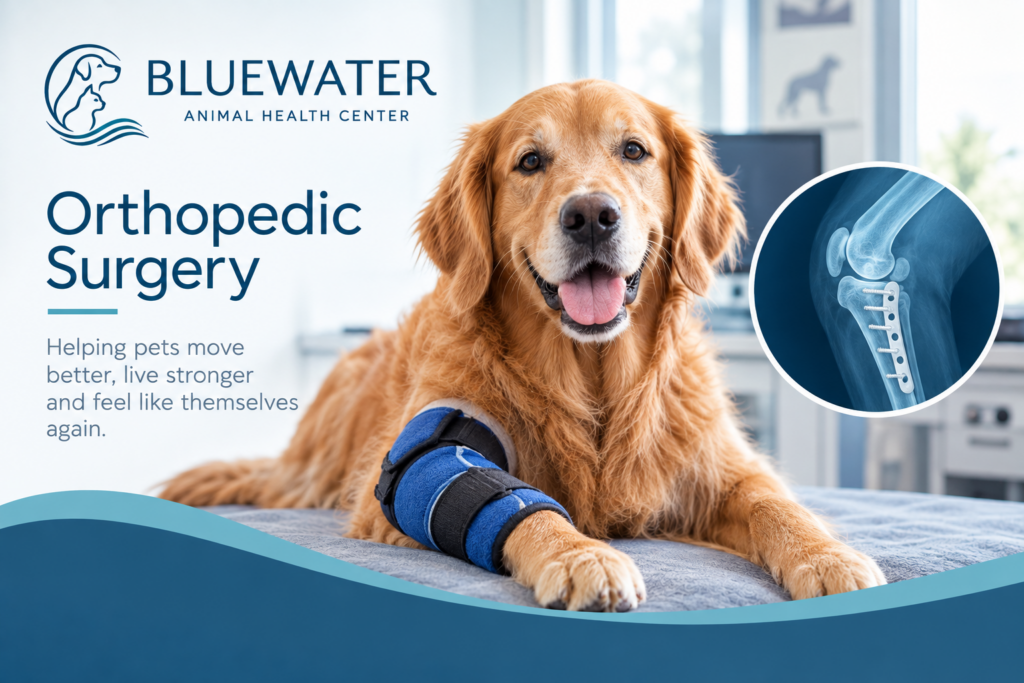
At Bluewater Animal Health Center, our orthopedic program is built on the same foundation as the rest of our practice: Dr. Alex Emerson listens carefully, explains what he finds, and makes sure every pet owner understands their options before any decisions are made. That includes cruciate ligament repair, TPLO surgery, fracture stabilization, and evaluation of joint conditions like hip dysplasia — all explained with the straightforward clarity Fort Lauderdale pet families expect from us.
Orthopedic Conditions We Evaluate and Treat
Orthopedic problems in pets span a wide range, from sudden traumatic injuries to conditions that develop gradually over months or years. The following are the conditions we most commonly see and treat at our Fort Lauderdale veterinary clinic.
Cranial Cruciate Ligament Disease
The most common cause of hind limb lameness in dogs — the canine equivalent of an ACL tear. Usually develops from gradual ligament breakdown rather than a single injury.
Hip Dysplasia
A condition where the hip joint does not fit together properly, causing pain and progressive mobility loss. Common in larger breeds but can affect any dog.
Fractures and Bone Injuries
Broken bones from trauma or underlying disease that require surgical stabilization to heal correctly and allow normal limb function to return.
Luxating Patella
A kneecap that slips out of position, often seen in smaller breeds. Can cause intermittent lameness or a distinctive skipping gait.
Arthritis and Joint Degeneration
Chronic inflammation and cartilage loss that develops with age or following injury. Ongoing management is often needed alongside any surgical repair.
General Joint Instability
Ligament laxity or structural instability that affects how a joint loads and moves, leading to discomfort and eventual damage if left untreated.
One pattern worth noting with cranial cruciate ligament disease: according to research reviewed by the American Veterinary Medical Association (AVMA), cruciate ligament rupture is influenced by a combination of factors including degeneration, obesity, genetics, and breed — and a dog diagnosed with a cruciate injury in one knee is at meaningful risk of developing the same condition in the opposite leg. Because of that pattern, we evaluate both hind limbs during any cruciate-related exam, not just the one showing obvious symptoms.
Signs Your Pet May Need an Orthopedic Evaluation
Because dogs and cats are skilled at masking discomfort, symptoms that look mild on the surface can point to more advanced joint damage underneath. Any of the following warrants a prompt evaluation.
🐾 Persistent Limping
Any limp lasting more than a day, or one that comes and goes, should be evaluated rather than monitored at home.
🚴 Reluctance to Move
Hesitating to jump, climb stairs, or get into the car is often the first sign that a joint or limb is causing pain during load-bearing.
🩹 Swollen or Warm Joints
Visible swelling, heat, or stiffness around a joint indicates active inflammation that needs evaluation regardless of how well the pet appears to be moving.
😏 Behavior Changes
Becoming quieter, less interested in play, or more irritable than usual can reflect chronic pain that a pet is no longer able to fully conceal.
📅 Stiffness After Rest
A pet that moves stiffly after sleeping or lying down, then loosens up with movement, often has joint inflammation or early degenerative disease.
⚠ Sudden Inability to Bear Weight
A dog or cat that abruptly stops putting weight on a leg needs prompt evaluation — this can indicate a fracture, ligament rupture, or joint dislocation.
How We Diagnose and Plan Orthopedic Treatment
We don’t recommend surgery without first confirming exactly what’s causing a pet’s discomfort. Every orthopedic evaluation at Bluewater Animal Health Center starts with a hands-on physical exam, a gait assessment, and a detailed conversation about how symptoms have changed over time. Radiographs are used whenever imaging is needed to see the full picture of what’s happening at the bone and joint level.
1
Physical Exam and Gait Assessment
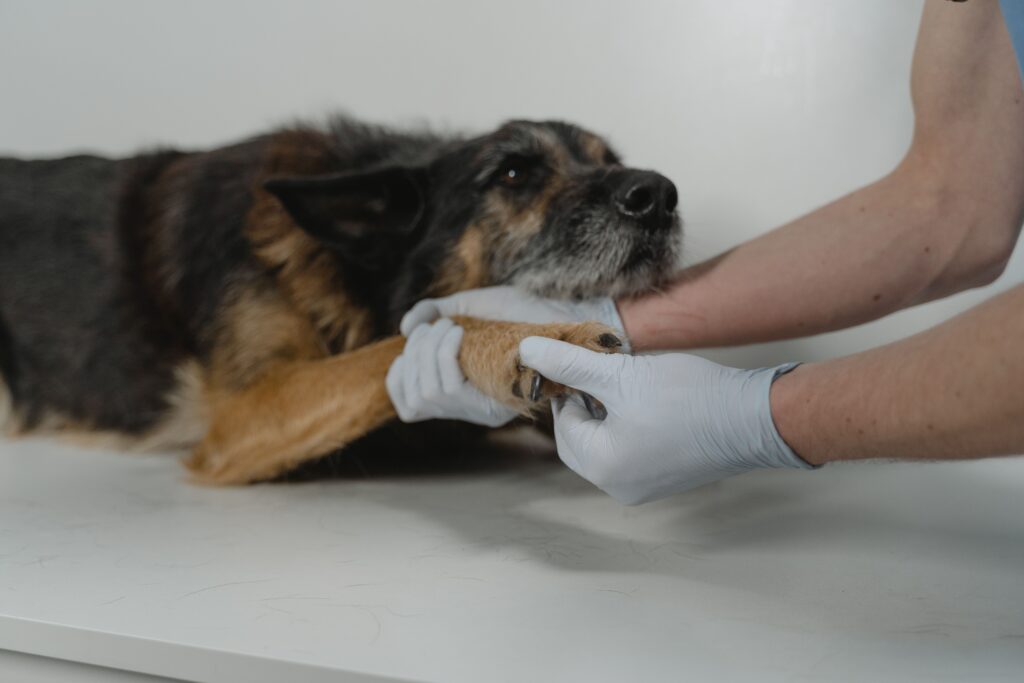
Dr. Emerson evaluates limb movement, joint stability, muscle symmetry, and pain response. We assess both affected and unaffected limbs to catch any compensatory patterns.
Dr. Emerson evaluates limb movement, joint stability, muscle symmetry, and pain response. We assess both affected and unaffected limbs to catch any compensatory patterns.
2
Diagnostic Imaging
Radiographs allow us to evaluate bone structure, joint spacing, and the degree of any arthritic change or bone damage before making any surgical recommendation.
Radiographs allow us to evaluate bone structure, joint spacing, and the degree of any arthritic change or bone damage before making any surgical recommendation.
3
Pre-Surgical Bloodwork and Anesthesia Planning
Before any procedure, we review a pet’s overall health and run pre-surgical bloodwork to confirm they are a safe anesthesia candidate. Anesthesia safety and monitoring are part of the plan we discuss with every owner.
Before any procedure, we review a pet’s overall health and run pre-surgical bloodwork to confirm they are a safe anesthesia candidate. Anesthesia safety and monitoring are part of the plan we discuss with every owner.
4
Surgery
We perform ACL repair, TPLO surgery, fracture stabilization, and other orthopedic procedures as each case requires. For cruciate repair, TPLO is generally favored for larger, more active dogs because of how it mechanically stabilizes the knee. Smaller or less active patients may be better candidates for other approaches — we talk through those options honestly rather than defaulting to a single technique.
We perform ACL repair, TPLO surgery, fracture stabilization, and other orthopedic procedures as each case requires. For cruciate repair, TPLO is generally favored for larger, more active dogs because of how it mechanically stabilizes the knee. Smaller or less active patients may be better candidates for other approaches — we talk through those options honestly rather than defaulting to a single technique.
5
Recovery Plan and Follow-Up
Every surgical patient goes home with a specific activity plan. Scheduled rechecks let us monitor healing on imaging and adjust the recovery plan as needed through each phase.
Every surgical patient goes home with a specific activity plan. Scheduled rechecks let us monitor healing on imaging and adjust the recovery plan as needed through each phase.
What Recovery Involves After Orthopedic Surgery
Surgery is only half of a successful outcome. What happens during recovery has just as much influence on whether a pet regains full, lasting use of the limb. Too much movement too soon is one of the most common reasons a repair fails to hold, which is why we send every surgical patient home with a specific, written activity plan rather than general guidance.
- Keep activity limited to short, controlled leash walks as directed — no running, jumping, or rough play.
- Use a crate or confined space indoors to prevent sudden bursts of activity.
- Check the incision site daily for swelling, redness, or discharge.
- Follow the prescribed pain management plan through the full recovery window, even when a pet seems comfortable.
- Attend every scheduled recheck so healing can be confirmed on imaging before activity is gradually increased.
For dogs managing longer-term joint changes after surgery, we also share practical guidance through resources like our tips on supporting an arthritic dog at home, since arthritis management often continues well after the surgical site has healed. Our mobility and comfort care services are also available to support pets navigating ongoing joint health challenges.
Which Pets Are at Higher Risk for Orthopedic Problems
Breed, body weight, and life stage all influence a pet’s orthopedic risk. Large and giant breeds carry a higher baseline risk for cruciate disease and hip dysplasia. Overweight dogs of any size place more load on joints with every step, accelerating wear and increasing the likelihood of ligament failure. Small breeds tend toward luxating patella and other structural joint issues. Senior pets benefit from orthopedic evaluation as part of their senior wellness care, since joint disease that develops gradually can be harder to catch before it becomes significantly limiting.
Catching orthopedic disease early consistently means more treatment options, a less complex procedure, and a better prognosis for a full recovery.
Orthopedic Care at Bluewater Animal Health Center
We know orthopedic visits often come with a fair amount of worry — about the diagnosis, the surgery, and the road ahead. Dr. Emerson approaches every orthopedic case the way he approaches the rest of his practice: listening closely, explaining clearly, and making sure owners understand exactly what’s happening with their pet and what each option involves before any decision is made. No pressure, no assumptions, just the information you need.
Schedule an Orthopedic Evaluation in Fort Lauderdale
Orthopedic problems rarely improve with time alone, and the sooner we evaluate a limp or mobility change, the more treatment options are available. Whether your pet has a sudden injury or a joint issue that has been building gradually, we are here to walk through what is going on and what the best next step looks like for that specific animal.